Import & Export
Bring patterns into Needlework Studio from multiple file formats and export them for printing, sharing, or use in other software.
Some features on this page require the Full Version.
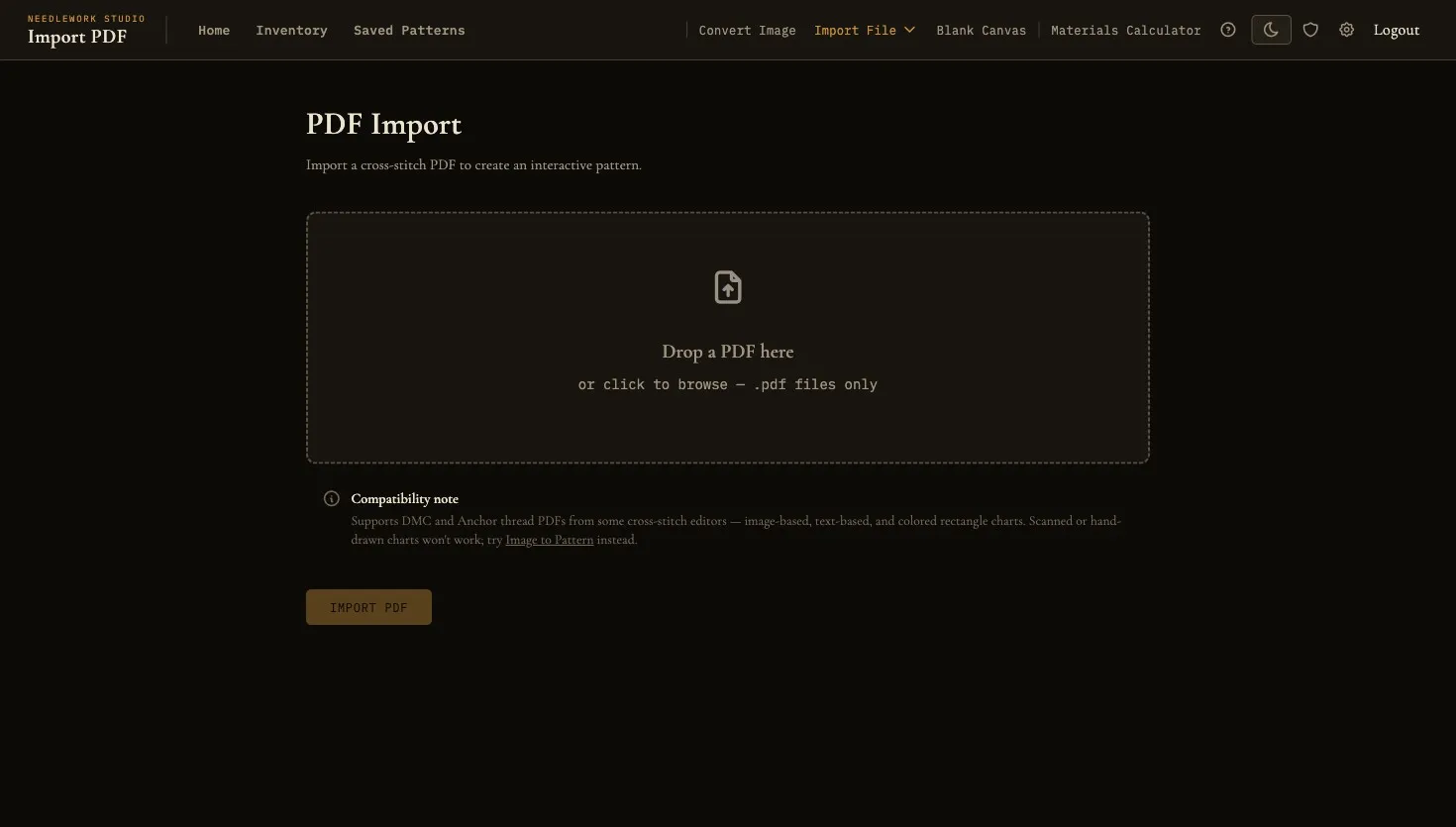
The PDF import interface for uploading cross-stitch pattern charts
Import Formats
Needlework Studio can import cross-stitch patterns from three file formats. All import options are in the Create section of the navigation bar, under Import File: PDF Pattern, JSON Pattern, and OXS Pattern.
JSON and OXS import work in every version. PDF import needs the Full Version. On the Free version an imported pattern also counts toward the 10-pattern limit.
PDF Import
The PDF importer handles cross-stitch chart PDFs - the kind you buy from pattern designers or download from online shops. It parses the chart pages to extract the pattern grid, color legend, and stitch data. Both DMC and Anchor thread legends are recognized.
A note on designers. PDF import is for charts you have bought or made yourself, so you can stitch them your way on screen. Designers put a lot of work into their charts. Please respect their copyright, and do not share, post, or sell charts you have imported.
Three chart types are read as a full, editable stitch grid:
- Image-based charts - Each grid cell is a small embedded image. This is the format most third-party pattern designers use.
- Text-based charts - Grid cells use text symbols (letters, numbers, special characters) with a symbol-to-color legend. This includes PDFs exported by Needlework Studio itself, which produce a perfect round-trip with 100% cell accuracy.
- Colored rectangle charts - Grid cells are vector-drawn colored rectangles, matched to the legend by fill color.
How it works:
- Upload - Drop a PDF onto the page or click to browse for one. PDFs can be up to 25 MB. If the PDF has several pages, you are asked to choose the pages to import: pick the chart pages and leave out title pages, color keys, and duplicate versions.
- Preview - After upload, Needlework Studio displays a preview of the parsed pattern along with the extracted thread legend. Review the preview to verify that the chart was parsed correctly. The preview shows the full grid with colors and symbols as they were interpreted from the PDF. Each legend entry includes a status dot indicating whether you own, need, or don't own the thread, cross-referenced with your Thread Inventory.
- Name and save - Enter a name for the pattern and click Save Pattern to add it to your library. Afterward you can jump to View Pattern, the Materials Calculator, or Import Another. If a chart came in as an editable pattern but you would rather work from the original page, choose Stitch over the original instead.
Most chart PDFs come in as a full, editable pattern with their thread legend. When a chart cannot be read as a stitch grid, because it is a scanned page, a photo, or an image-only export, Needlework Studio brings it in as a stitch-over reference image instead. The chart sits on your canvas at the right size, and you line it up with the grid and stitch over it in the editor, so you can work from it on screen even when the grid itself cannot be parsed. If a PDF has more than one chart page, the pages are laid out together so you can follow the whole design across them. See Stitching Over a PDF Chart for the whole process.
The only PDFs that cannot be imported are ones with no chart on them at all, such as a cover sheet or a floss list, and those come back with a clear message saying what was missing. To turn a photograph into a brand new chart of your own, use Image Converter instead.
Specialty stitches. Some chart formats render specialty stitches (backstitches, French knots, beads, part stitches) as separate vector layers in the PDF; for those, the importer can pull the layers out alongside the full-cross grid. Most chart PDFs flatten everything into a single image and only yield full-cross stitches on import - if specialty stitches are missing from the imported pattern, you can add them in the editor.
JSON Import
JSON is Needlework Studio's native pattern format. JSON files contain the complete pattern data structure including the stitch grid, thread legend, part stitches (half, quarter, three-quarter), backstitches, French knots, beads, and all metadata. This format preserves every detail of the pattern with perfect fidelity.
Common uses for JSON import:
- Transferring patterns between Needlework Studio instances (for example, from one server to another).
- Restoring a pattern from a backup.
- Sharing patterns with other Needlework Studio users who do not have access to your server.
To import a JSON file, choose Import File then JSON Pattern, choose the file, review the preview, enter a name, and save.
OXS Import
OXS (Open Cross Stitch) is an XML-based standard format designed for interoperability between different cross-stitch software applications. Importing an OXS file allows you to bring patterns from other cross-stitch programs into Needlework Studio.
The OXS format supports full stitches, part stitches, backstitches, French knots, beads, and thread color definitions. Needlework Studio maps the thread colors in the OXS file to the closest matching DMC or Anchor threads in its database, using perceptual color matching when an exact match is not available.
Per-entry brand attribution. When the OXS file labels a thread with a brand prefix, Needlework Studio reads the brand per legend entry instead of forcing every thread into a single brand. DMC and Anchor entries map to their full thread records in your Thread Inventory; specialty-brand entries (such as those used for beads or metallic threads) keep their brand label on the legend even when the brand isn't in the inventory, so the original attribution survives the import.
In the Full Version an imported pattern can be up to 1000 × 1000 stitches and carry up to 500 legend entries. Files beyond either limit are rejected with an error message rather than being silently trimmed.
To import an OXS file, choose Import File then OXS Pattern, choose the .oxs file, review the imported pattern, name it, and save.
Progress Import
Beyond importing whole patterns, you can import your stitching progress into a pattern you already have. From the Saved Patterns gallery, the Import Progress button reads a progress file (.pk_progress or .sp) saved by other stitching apps and marks the matching cells complete on the corresponding Needlework Studio pattern, so you do not have to re-mark finished stitches by hand.
Pick the progress file, choose which of your patterns it belongs to, and the completed cells merge into that pattern. The pattern dimensions must match the progress file exactly, or the import is rejected with a clear message. This release carries over full-cross progress; backstitches and French knots are not included.
Import Workflow
Regardless of the file format, the import workflow follows a consistent sequence:
- Choose file - Select the file from your computer using the file picker dialog.
- Preview with legend - The imported pattern is displayed as a preview alongside its thread legend. Review the preview carefully to confirm that the pattern was parsed correctly. Check that the colors look right, the dimensions match what you expect, and the stitch types are properly represented.
- Name pattern - Enter a descriptive name for the pattern. This name will appear in your pattern library and can be changed later.
- Save - Click the save button to add the pattern to your library. The pattern is now available in the Saved Patterns gallery, where you can open it in the Pattern Viewer or the Pattern Design editor.
Export Formats
Needlework Studio can export saved patterns as PDF, SVG, PNG, OXS, JSON, and shareable HTML. Open a pattern card's ... menu in the Saved Patterns gallery and choose Export. To export several patterns at once, click Select, pick the patterns, and use the export action in the bar that appears.
JSON and PNG export work in every version. On the Free version, PNG images carry a small "Created with Needlework Studio" line in the corner. PDF, SVG, OXS, and HTML export need the Full Version.
PDF Export
The PDF exporter generates a multi-page vector document optimized for printing, offline use, and compatibility with popular mobile stitching companion apps. The exported PDF includes:
- Cover page - A title page showing the pattern name, a thumbnail preview of the design, overall dimensions in stitches, thread count, and other summary information.
- Tiled grid pages - The full pattern chart is split across multiple pages in a tiled layout. Symbols are rendered as selectable vector text using an embedded TrueType font (DejaVu Sans), and grid lines are drawn as vector paths, so the chart stays crisp at any zoom level. Bold grid lines mark every 10th row and column, and every page carries row and column numbers, which is how you line up one page against the next.
- Legend page - A complete thread legend listing every color used in the pattern with its symbol, DMC or Anchor thread number, color name, strand count, stitch count, and a color swatch. This serves as your shopping list and reference while stitching. The legend format is compatible with the automatic legend detection used by popular stitching companion apps.
The PDF is laid out on A4 pages, with high-contrast colors and symbols that stay legible in black and white. The output is vector-based, so exported PDFs can be re-imported into Needlework Studio with perfect round-trip accuracy.
SVG Export
The SVG exporter produces a vector graphics file of the pattern chart. Because SVG is a vector format, the output can be scaled to any size without loss of quality. This makes it ideal for:
- High-quality printing - Print the chart at any size, from a small reference card to a large poster.
- Editing in vector software - Open the SVG in applications like Inkscape, Adobe Illustrator, or Figma to add custom annotations, borders, or labels.
- Web publishing - Embed the chart on a website or blog post as a scalable image.
The exported SVG includes the full grid with color fills and symbol overlays, matching the appearance of chart mode in the Pattern Viewer, plus a title, rulers, and a color legend.
PNG Chart Export
The PNG exporter renders the pattern chart as a raster image. The exported PNG includes the full chart grid with all stitches, colors, symbols, and gridlines, matching what you see in the Pattern Viewer. Useful for:
- Quick sharing - Send a chart image directly in a message, email, or social media post without requiring the recipient to have any special software.
- Embedding in documents - Insert the chart image into word processors, presentation slides, or other documents that do not support SVG or PDF embedding.
- Reference thumbnails - Generate a standalone image of the chart for use as a visual reference or catalog thumbnail.
PNG export is available from each pattern card's Export menu and as a bulk export option from the Saved Patterns gallery. The exported image uses a fixed cell size for crisp rendering and includes row and column rulers along the edges for orientation.
Outline Export
From a pattern's menu, Export outline saves just the backstitch outlines with none of the filled stitches. You get the line work on its own, which reads well as a line drawing and works as a stitching guide when you want to see the shapes without the color.
PNG is available in every version. PDF and SVG need the Full Version.
If the pattern has no backstitch yet, the editor's Outline tool can add it. See Pattern Design.
HTML (Shareable) Export
HTML (Shareable) saves the pattern as a single web page with a chart viewer built in. Anyone can open it in a web browser to look at the chart, without installing Needlework Studio.
OXS Export
Export your pattern in the Open Cross Stitch XML format for compatibility with other cross-stitch software. The OXS file includes full stitches, part stitches, backstitches, French knots, beads, and thread color definitions. This is the best format to use when you need to share a pattern with someone who uses a different cross-stitch application.
JSON Export
Export the pattern in Needlework Studio's native JSON format. The JSON file contains the complete pattern data with full fidelity, including:
- The stitch grid with all full stitch data
- Part stitches (half, quarter, three-quarter) with position and orientation
- Backstitches with start and end coordinates
- French knots with positions
- Beads with positions
- The complete thread legend with DMC/Anchor thread references
- Fabric color
- The pattern name and dimensions
JSON export is the recommended format for backups, archiving, and transferring patterns between Needlework Studio instances, because it keeps every stitch exactly. It does not include your stitching progress, notes, or tags. Backup All (below) adds notes, designer, and tags, but not progress.
Backup All
The Backup All button in the Saved Patterns gallery exports your entire pattern library as a single ZIP file. Each pattern is saved as an individual JSON file inside the archive, with its notes, designer, and tags written into the file. You can bring any or all of the patterns back later with the JSON import. That import restores the pattern itself, not its notes, designer, or tags. Stitching progress is not included. Backup All needs the Full Version.
The downloaded file is named needlework-studio-backup-YYYY-MM-DD.zip with the current date. This is the fastest way to create a full offline backup of your work, and it pairs well with the JSON import if you ever need to move to a new server or recover from data loss.